Articles Archive for November 2005
Pre Training »
The course outlines for the classes I will be taking at Seneca are now on line.
Aeronautics
The main textbook is “From the Ground Up” which I’ve already done about two thirds of the workbook. Some highlights:
1. Components, structure, loads, stresses, documents
2. Bernoulli’s Theorem, Newton’s Laws, airfoils and production of lift, weight and C of G, drag, couples and turning moments, wing design, high lift devices, attitudes and movements, stability and control, flight performance
3. Flight instrument, pitot-static system, gyroscopic principles, magnetic …
Pre Training »
I got a call back from the FI I did my intro flight with the other day and she was able to answer all of the questions I had.
She said that it might be possible for me to write my PSTAR exam before becoming an “official” student at the school. Just to come in when the weather is crappy (I’m presuming that’s when the CFIs have nothing better to do). However, writing the Radiotelephone exam (for my radio license) would have to wait.
In the meantime I’m continuing my studying. I …
Airmanship »
The rear of an airplane both in the air and on the ground is a dangerous place. In the air you have to concern yourself with wake turbulance (not caused by the engines, but the wingtip vorticies). On the ground you have to worry about Jet and Prop blast.
This “danger zone” is different depending on the type (jet/prop) and size of the aircraft. Below is the areas around an airplane where jet blast is dangerous.
Jumbo Jet
Medium Jet
Executive Jet
Idle
Take-Off
Idle
Take-Off
Idle
Take-Off
Length
600ft
1600ft
450ft
1200ft
200ft
500ft
Width
250ft
275ft
150ft
80ft
A diagram is also available.
Pre Training »
Radio communication is a very important part of a pilots duties. There is specific protocol that needs to be followed in order for you to get your message across clearly in the shortest amount of time possible. Take a look at this example:
Controller: “American 1778, contact tower now on 122.8. Good day”
Aircraft: “Contact tower on 122.8, American 1778″
This is called a “hand-off”. This particular aircraft wants to land, and the controller knows this because of the flight plan that was filed before the flight took off from their origin. The …
Pre Training »
Seneca has finally updated their website with class schedules and information. Classes start the first week of Janurary! Here is what my schedule will look like:
Monday: Human Factors
Tuesday: Meterology
Wednesday: Aeronautics
Thursday: Computer Systems
All classes are from 6:30pm – 9:30pm At Buttonville Airport, with the exception of Computer Systems. I’m going to try to see if I can get a credit for not actually attending the Computer Systems classes as the cirriculum is stuff I already know. So this first semester, the cost will be about $1500, plus $5,000 for the tuition.
I’m …
Interesting Things, Pre Training »
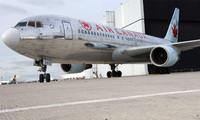
I never thought that paint could be so heavy! In an effort to save cash, Air Canada is stripping some of their aircraft of most of its paint. Leaving the “au naturel” polished aluminum to bare the brunt of the elements. According to Air Canada, the paint weighs 360 pounds and takes about 12 days to strip off the airplane. This results in a fuel savigns of $24,000 per airplane. With 45 Boeing 747s that can result in a total savings of $1,080,000 a year!
This just proves how tight profit …
Interesting Things, Pre Training »
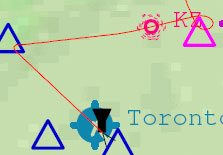
FAA Flight information is available to the public (I’m still trying to figure out how I can get that data). Aaron Koblin put together some pretty spiffy videos of this data. Each dot represents an airplane flying to or from the US.
Be sure to check out the “overview documentation” (a video) on his website to understand how to interpret the data.
Pre Training »
Went to the Seneca Open House with Melissa today. We were both somewhat disappointed, nobody was able to answer any of my questions about their part time course. I kept on getting redirected “to the website” and I kept on reminding them that it was out of date. I spent most of the time talking to the students. One showed me around the place. The Fracas simulators are pretty pimp. They have two, one for Cessnas and another that has a glass cockpit for (I think) a jet engine plane. …
Navigation, Pre Training »
After reading over the chapter on radio navigation, I decided to try it out – using Microsoft Flight Simulator 2004.
I hopped in my Cessna 172, and departed Buttonville on runway 33. I climbed up to 4,000 feet and turned on the autopilot and told it to hold this altitude. First item on the list, understand how the ADF works. The ADF is a simple device that points you in the direction of the radio beacon. A simple arrow on a dial. Just turn the airplane until the arrow points straight …
Pre Training »
I haven’t been doing as much studying these past two weeks as I would like. I’m at the “navigation” chapter in my textbook and I am missing some tools that I need in order to complete them. Mainly a “real” E6B, some protractors and rulers.
I’m actually pretty excited about the Seneca open house this weekend. I’m going to chat with the FI I had my intro with after to get some feedback from her about what I plan on doing:
I’m going to pummel the Seneca people about their curriculum and …