Days since beginning: 1067
You can be notified of when this site is updated!
At: Dec 04 2008 23:00Z
|
Monday, February 27, 2006 - 22:51:38 ET
I started doing circuits today. Fun stuff. I don't think that I will ever get bored of them. I have a lot to write about but I'm going to make this one short (and update you about other stuff in another entry).
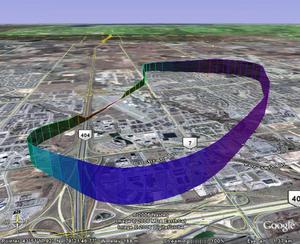
I wish there is an archive of METARs and SPECIs online. So that I can go back to the time of the flight to see what the posted visibility is. If anyone knows of one, please let me know. In any case.. it was bad. At one point in the circuit, we couldn't see the airport (on the base leg). According to my measurements in Google earth, the visibility was less than 1.5SM. So what we ended up doing, was follow woodbine south until we saw the runway, then corrected. To better illustrate, you can download the track for Google Earth or you can see a Google Maps version. One thing to note though is that the elevation/altitude data from the GPS is pretty inaccurate. It doesn't have a pressure altimeter in it so it calculates its height based on triangulation. Comments (3) | Permalink | Category: Training
Thursday, February 23, 2006 - 15:53:53 ET
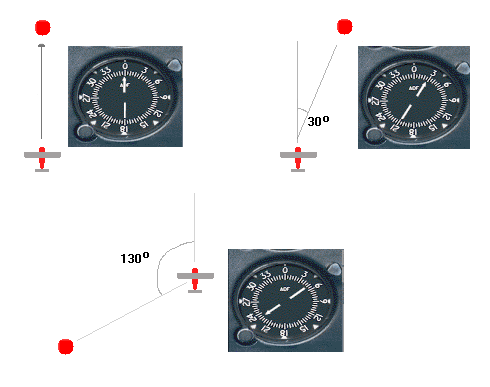
This is a repost from Aviatrix's latest post. First, some background: ADF Is a navigation tool thats based on AM radio signals. The way it works is that there are a bunch of "stations" (called NDBs, Non Directional Beacons) all over Canada that broadcast this AM signal that you use for direction finding. There is a compass in the cockpit with an arrow that points to the ADF station you have dialed in. You also know that you are dialed into the right station because it broadcasts morse code. The morse code is its identifier as each station has a unique name. For example the NDB near Buttonville is "KZ", so the morse code you'd hear is " -.- --..". This code is also printed on the map, so you can just match up the dots and dashes. Since you know the location of the station (because its on the map) you can simply line up the nose of the plane with the arrow in the cockpit to head straight for it. You know you've passed the station when the arrow flips 180°. ![]() Because it's AM based, you can also dial in commercial AM radio stations (you could even use them as an NDB if you want). Thats why you hear the radio guys say "CKFM" as it is the "official" name of the broadcasting station (and it would be broadcasting its morse code if it was a dedicated NDB)... Anyways.. on to the story:
Here is the ADF story I promised. I heard it from a pilot at a training course, years ago. The crew is flying a heavy Boeing into Vancouver, the captain's home town. It's a VFR morning, and Vancouver has an ILS so they don't need the ADF. They have had it tuned to a local AM radio station since before the top of descent, and are listening to the tunes, the traffic, the weather, and a phone in contest. Tenth caller wins! The captain pulls up his cellphone out of his flight bag, turns it on, and dials in. "Congratulations! You're the tenth caller." It turns out that this is the same radio station that many of his colleagues listen to. In fact people he knows are listening to it at that very moment. They recognize his voice. And they recognize the steady whoosh-grind sound of the jet engines as heard from the cockpit. And of course everyone knows you're not supposed to be using your cellphone in an airplane. Especially while you're the one landing it. The DJ asks the captain his first name, and he gives it. The DJ can hear the background noise, too, but he can't place it. "What are you doing right now?" he asks. There's a bit of a pause, and then the captain replies "I'm ... driving ... a .. truck." No word on what the the prize was, or even if this really happened. But I like the story. Comments (2) | Permalink | Category: Interesting Things
Monday, February 20, 2006 - 09:14:43 ET
My last two lessons have been canceled because my FI is sick. Get better soon! My midterms are coming up this week (and next). I've been studying for my Human Factors midterm on Saturday and I'm going to spend the most of the day today doing so as well. The second half of this class is going to be my favourite. We will actually get assigned a bunch of TSB accident reports and have to diagnose what human factors played a role in causing the accident. Make a presentation and present it to the class. Registration for the summer semester starts on March 27. I dont know what courses will be offered yet, however, if I use last years semester as an example: - Aeronautics I wanted to take 4 classes in the summer as well, however i'm taking Aeronautics now. We'll see what happens. I haven't had time to think of which patth my flight training is going to take yet. I will probably do some of that investigation later today. Comments (2) | Permalink | Category: Training
Monday, February 13, 2006 - 13:26:30 ET
Can it be? Three in a row?! Yes, well.. sort of. The weather today was looking marginal for finishing up practicing spins and spirals. So I decided today would be better spent on a ground briefing than in the air. I was still able to get in 2 flights this weekend. Saturdays flight was probably the best lesson I've had to date. I felt really comfortable at the controls and not once did I not feel unprepared. The weather was great too! This was the first time (for me) that the plane had de-icing fluid on it. It looked like someone spilled Orange Crush all over the plane. I was warned to not get any of it on my clothes as it can stain. Preflight and walkaround was uneventful. My take off this time was much better. The advice the FI gave me last time helped! We headed to the practice area to practice stalls. This is where the FI noticed that the ammeter was showing a low voltage. We spent some time trying to troubleshoot the problem. We had turned around to head back to the airport when we tried one last thing. It worked! Problem solved, we turned around and kept on practicing (with a close eye on that ammeter). I was actually having a lot of fun stalling the airplane. We practiced power off recoveries, and power on recoveries. We also practiced some "pretend" circuits out in the practice area. It was good fun. Heading back was good too. I was able to identify the landmarks I needed in order to figure out where I was heading. I made the radio calls coming into the zone: Me: "Buttonville tower, Cessna 172 Golf Foxtrot Alpha Kilo Echo with information Golf" So we wait.. we pass over our first reporting point and are about to enter the zone. We arn't sure if we were cleared into the zone yet. [Some discussion after yielded that we were probably ok to enter, since we were not told otherwise]. My FI tells me to turn the plane (so that we don't enter the zone) just as that happens, the Tower gets us on the Radio and we proceed to the airport. It's busy today! Yesterdays lession was fun as well. Today we were doing spins. Had a little trouble starting the engine, took a few seconds to realize that I left the fuel mixture full lean, instead of full rich. With that fixed, the engine started on the first go! I think this was the best take off I've done yet. Still a little too nose high. Heading to the practice area seemed to take longer than normal. The FI said that it was probably due to the winds. When we arrive, we get right into spins. They are just as fun as I thought they'd be - except we had some trouble getting the airplanes into a spin (they were developing into spirals). We had done about 5 or 6 before I started getting sick. I don't start feeling sick until we pull out of the dive. The g-forces is what gets to me. It's a challenge because when you are in the spin, the yoke is pulled really far back (because you are stalled). so in order to break the stall you only have to move the yoke a little bit forward, but its no where near neutral. In any case, I will need to practice recovering from a spin one or two more times before we can move to spirals. The difference between the two are: Spins: Spirals: My FI doesn't teach me how to enter a spin or spiral (thats saved for the Commercial) but we need to know how to exit from one. I've started taking on more tasks this lesson again. Getting used to how the radio works (ie, thinking ahead to pre-dial in frequencies I need to talk to). I'm making all of my radio calls except for in the circuit and on the Unicom in the practice area. Today's ground briefing was all about the circuit and illusions. I'm actually looking forward to my circuit work. I can't wait to get to that stage since I will be able to focus on my take-offs and landings. I spoke briefly with my FI about what should I start thinking about once I get my PPL. Yes I want to eventually get my ATPL, but there are many routes to get there. I'm going to spend the next few days doing some research and figure out how I want to get there. All of the numbers are now up to date. Comments (0) | Permalink | Category: Training
Thursday, February 9, 2006 - 13:02:44 ET
This clip is a good example of a language barrier that could cause potential problems with air traffic. It looks like the controller was telling the pilot that the flight level was available until a certain point, however both the pilot (and my self) didn't understand. Listen to the clip here. Also interesting to note: they use meters instead of feet overseas. Comments (0) | Permalink | Category: Interesting Things
Wednesday, February 8, 2006 - 23:11:46 ET
I'm sure you've heard the news. Steve Fossett is trying to break the longest flight record in his Virgin Atlantic Global Flyer. I'd be interesting to see if anyone is able to capture some clips of his travels on LiveATC.net. His route takes him over Canadian airspace (specifically Gander, NL) which LiveATC.net has a feed of. In other news.. My latest flight went well. We covered slow flight and endurance. Some new milestones this flight were: - I made my own copy of the ATIS for the first time! I swear I didn't hear the temperature and dew point. But my FI said it was there! My radio work has improved. I don't feel as awkward on the radio any more.. I'm going to continue to practice on my own. I feel like such a loser talking to my self out loud - I just make sure nobody can hear me! ;) Slow flight is interesting and this was the first time I was in the airplane with 40° of flaps. It really brings the nose down a lot! I feel like I should be plummeting to the ground in this attitude. We were doing all of the air work at probably the highest I've ever been (around 4500-6000'). There are four indications you can use to determine you are in slow flight: - Excessive nose up attitude Because of the excessive nose up attitude, you cant see anything in front of you. All you see is blue sky. Because of such you need to do a HASEL check. This check is done for certain maneuvers so that you can perform them safely. H - Height (when you exit the maneuvers you must be > 2000' AGL) One thing that I did not prepare for was the pre-landing checklist. I forgot to memorize this. Will have it done for next time. Just like with landing, with slow flight you control airspeed with attitude and altitude with engine speed. If you are in slow flight and are descending, then add more power. If you are going too fast, bring the nose up. It may sound counter-intuitive... but it makes sense. Because we were so high doing these exercises, we had to drop altitude quickly before we could start heading back to the airport. My FI put us into a slipping turn. Thats where you turn the airplane, but apply rudder in the opposite direction. We were getting a 1500 fpm descent rate while turning 180° to head back to the airport. I still need to work on my throttle control. I'm still hesitating in some situations, I hope to get that nailed down soon. My FI assured me that I'm progressing well and I'm starting to take on more tasks while doing my exercises. This is good. As it stands right now, March isn't looking good for flying. Most of the weekends are already booked by other people. 1.5 hours added to the count! Comments (0) | Permalink | Category: Interesting Things
Tuesday, February 7, 2006 - 09:31:11 ET
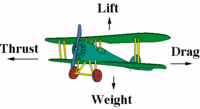
... according to one of my teachers. Let's start off with a little bit of grade 10 physics: There are four forces that act on an airplane: Lift, Weight (gravity), Thrust, and Drag. All of these forces are equal in straight and level flight. Rule of Flight #1: Lift always acts perpendicular to the wingspan (lateral axis). So what happens when we turn the airplane? We bank our wings. Remember rule number 1? The lift component also banks to stay perpendicular to the lateral axis: The two green arrows are the resolved vectors for the lift component (the red arrow). The horizontal green arrow is the horizontal component of lift (aka centripetal force), the green arrow is the vertical component of lift. Newtons third law states: For every action there is an equal and opposite reaction. And this is where (according to my teacher) is where the textbook gets it all wrong. The textbooks throw in that 5th force called centrifugal force. Let's go back to newtons third law. The key words in there being "action" not "force". The law does not state: For every force, there is an equal and opposite force. Let's pretend for a minute that this is the case, that for every force there is an equal and opposite force, and lets resolve our vectors. Do be doo... lets see... lift and weight will disappear.. what else.. hmm.. oh yeah, centripetal and centrifugal forces will also resolve to 0. So we're left with something that looks like this: So if centrifugal force existed (which, according to the textbook it does) then there would be no horizontal component of lift, and thus, no actual horizontal change in direction. So what exactly is happening? I'm going to leave that up to you (hint: it has to do with momentum and not force). Please leave a comment with your thoughts on this, positive or negative. Comments (6) | Permalink | Category: Interesting Things
Saturday, February 4, 2006 - 21:03:51 ET
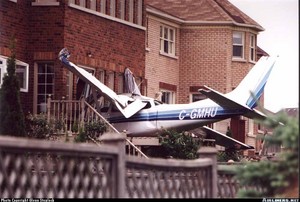
I happen to come across an image of an aircraft that smashed into a house. I decided to look up its registry and discovered that it took off from Buttonville! The accident report is availble on the TSBs website. Good news is that nobody was seriously hurt. Comments (3) | Permalink | Category: Interesting Things
Saturday, February 4, 2006 - 20:40:22 ET
Since my flight was canceled today because of the weather, I figured it would be a good time to talk about NOTAMs. A NOTAM is a NOTice to AirMen and it lets pilots and controllers know of things that are different or out of the ordinary. Lets take a look at some of the currently active NOTAMs for Buttonville: 060015 CYKZ TORONTO/BUTTONVILLE MUNICIPAL CYKZ PARAJUMPS 1 NM RADIUS 435230N 792730W (APRX 4 NM WNW AD) SFC TO 6000 FT MSL 1600/2100 DLY 0602041600 TIL 0602052100 It's pretty easy to decode this one. This NOTAM is to let pilots know that there are going to be Parajumpers jumping within a 1NM circle about 4NM west-north-west of the airport between the surface and 6000' 4PM to 6PM Daily between Feb 4 4PM and Feb 5 6PM. Times are in UTC (so really 11am to 2pm ET). There really is no limit to the length of a NOTAM, as seen in this one: 050351 CYKZ TORONTO/BUTTONVILLE MUNICIPAL CYKZ TWY C CLSD NORTH OF TWY A TO THR 15 AND SOUTH OF RWY 03/21 TO WEST SIDE OF RWY 15/33 TIL 0603312200 This one was created sometime last year, and wont expire until March 31, 2006. It says that Taxiway Charlie will be closed north of Taxiway Alpha to the threshold of runway 15. It is also closed south of runway 03/21 to the west side of runway 15/33. View image. These are two examples of local NOTAMs. NOTAMs that are issued by the airport and affect only the airport. A recent NOTAM was issued for Edmunston telling pilots that there was a deer on the runway. A little while later, the canceling NOTAM was issued: 060028 NOTAMC 060027 CYCL BATHURST CZBF DEER IN FREEZER I'm sure a few got a chuckle out of that one (I found that NOTAM at aviation.ca). There are also regional NOTAMs that affect a wider area. These NOTAMs usually offer amendments to some of the publications (CFS, Maps, etc..) that haven't been updated yet. These notices (along with others like METARs and data between traffic controllers) are sent using the AFTN (Aeronautical Fixed Telecommunication Network). This crusty network is based on the old teletype network and as such some of the codes are cryptic (stolen from Wikipedia): ZCZC DFA05 12032006 DD RCTPZQZX 1209 VTBBZQZX The ZCZC stands for start of message and is geared towards torn-tape stations where the Z and C characters will punch all five holes on the tapes providing a quick check to the operator that the tape-puncher is working correctly. The NNNN similar is a familiar one hole consecutive sequence which can be quickly identified as end of message by operators. Im sure those codes are redundant now as this information is displayed on computer screens instead of old teletype paper. Uncfourtunately there isn't a lot of (free) technical information about the AFTN. As far I understand the specs are located in ICAO's Annex 10 Vol 3. This Annex is available for $291. Searching for AFTN on Google Images yielded a network diagram of an AFTN system in the Czech. This page talks more about the setup: AFTN - two DEC Alpha 2100 computers with UNIX What better way to spend a snowy/rainy day than doing research on how information is disseminated in the aeronautical world! Comments (0) | Permalink | Category: Interesting Things
|
|