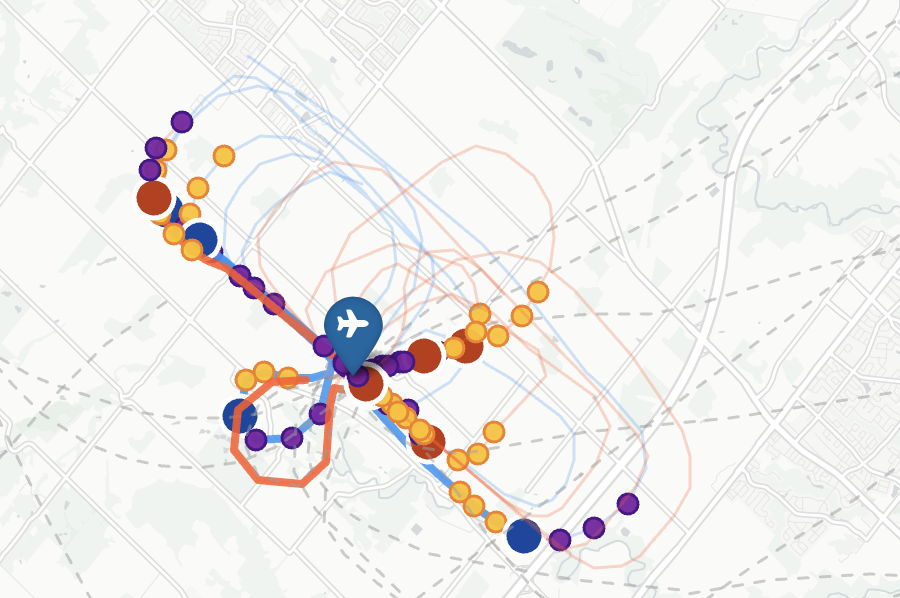
Pilots Love Arguing About Circuit Entries. So I Looked at the Data.
At uncontrolled airports, everyone has an opinion about the “right” way to join the circuit. Some pilots love the overhead join, yet others treat straight-ins like a war crime.
Adding fuel to the fire is the fact that there is no law that tells you what method to use. It is all just recommendations from Transport Canada.
However, suggestions are made in the Aeronautical Information Manual on which entry method should be used.
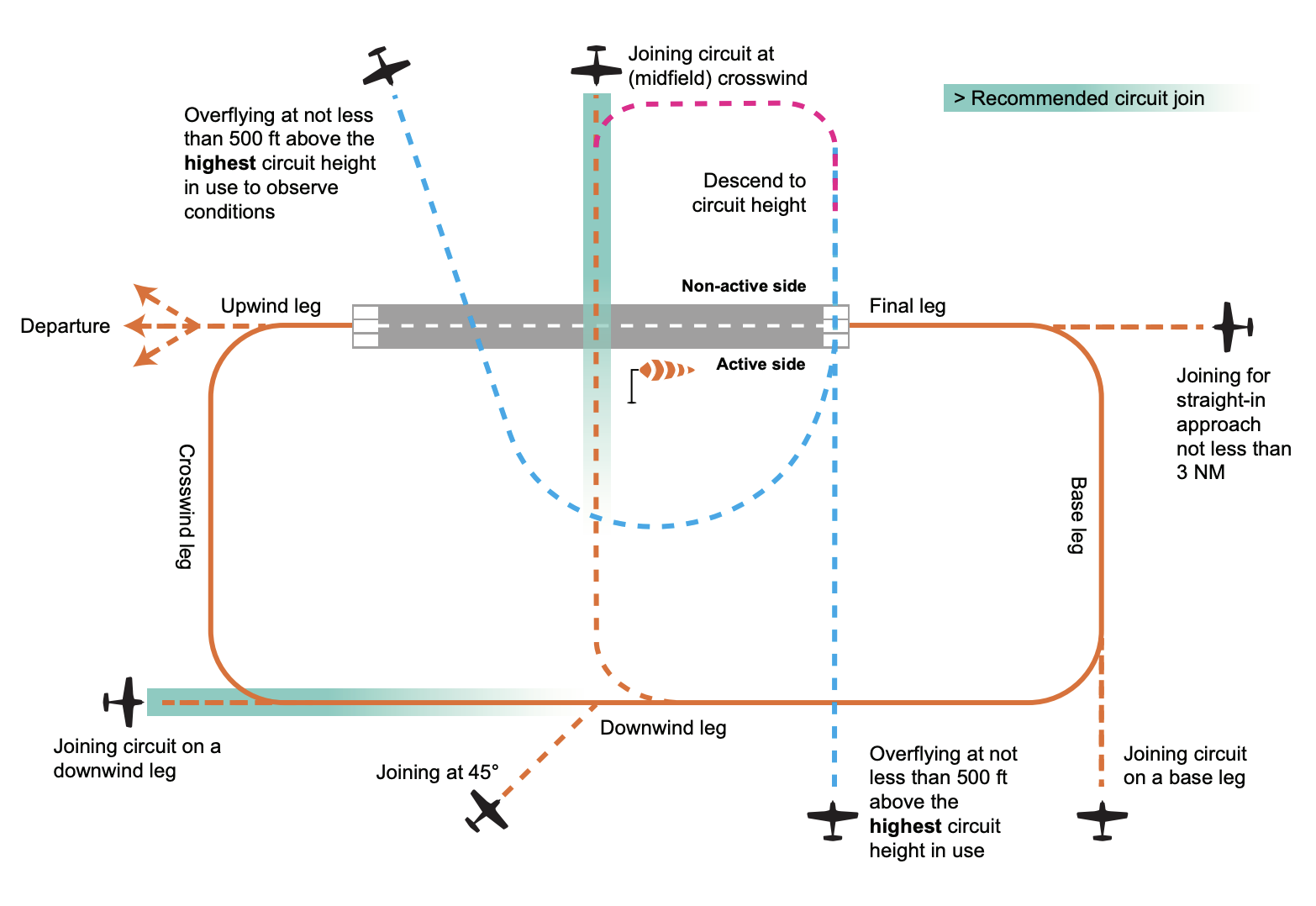
The only recommended join is the overhead (midfield crosswind) and the downwind leg. However all of the other entry methods are allowed. Complicating matters further is the fact that there are two types of uncontrolled airports: one with airport advisories (Mandatory Frequency) and others without (ATF). The AIM states:
For aerodromes not within an MF area: Where no MF procedures are in effect, powered aircraft should approach the traffic circuit from the non-active side (overhead join). Alternatively, once the pilot has ascertained that there will be no conflict with other traffic entering the circuit or established within it, the pilot could join the circuit on the downwind leg. Straight-in approaches are discouraged whenever there are other aircraft in the traffic circuit, as it may cause a conflict with other aircraft in the circuit and increase the risk of a mid-air collision.
For aerodromes within an MF area when airport advisory information is available: Aircraft could join the circuit pattern straight-in or at a 45˚ angle to the downwind leg or straight-in to the base or final legs
So I wanted to answer a simple question: Are pilots adhering to these recommendations, or is it really the “wild west” out there? I spent the next three weeks pouring over ADS-B data and coming up with an algorithm to detect all of the entry types plus some more interesting stats.
I was able to compile data from over 15,000 flights landing at 48 uncontrolled airports across Canada. The data spans a full 12 months in 2025.
The Big Picture
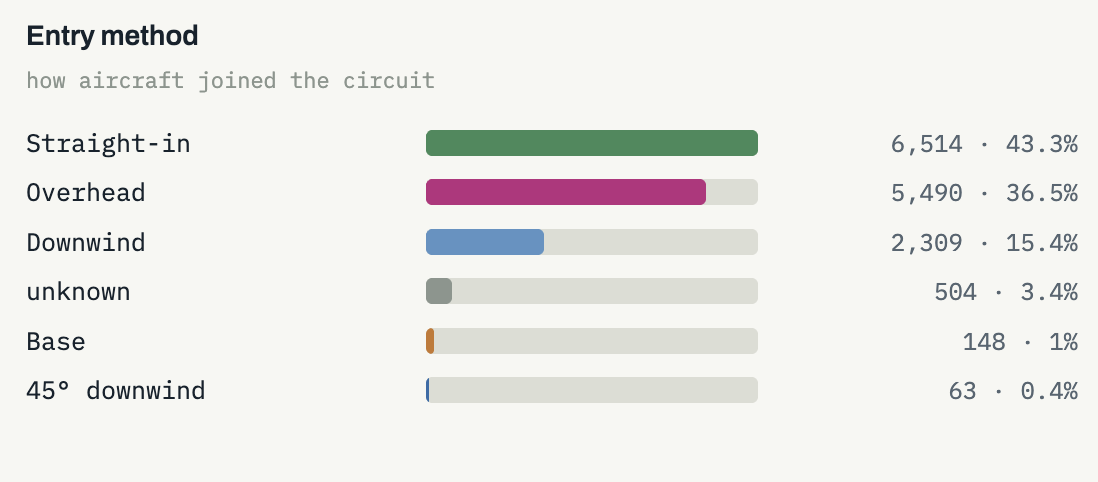
It’s no surprise that the top two entry methods are Straight-In and Overhead. The overhead join is particularly useful at uncontrolled airports as it gives you the opportunity to inspect the field conditions and wind direction before comitting to land. Most of the airports in Canada don’t have an airport advisory available to tell pilots the condition of the runway, etc..
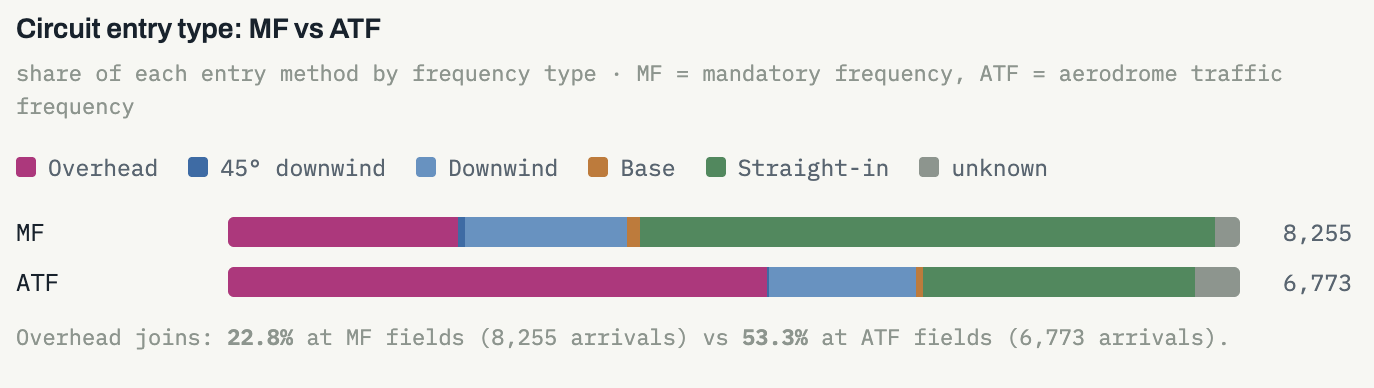
If we break this down by airport type (MF vs. ATF) we see that the majority of pilots prefer a straight in approach at MF airports vs. the overhead join.
The median distance for all airports where the straight-in commenced was 4.76 nautical miles from the threshold. This is important to remember as when you are flying a normal circuit you usually turn final at 1.5 nm from the threshold. So when on your base leg, always look left/right towards the final approach path to ensure that it is clear from someone entering in straight-in. Especially if the airport is quiet as the recommendation for straight-in approaches are only to be made when “no other traffic is in the circuit”.
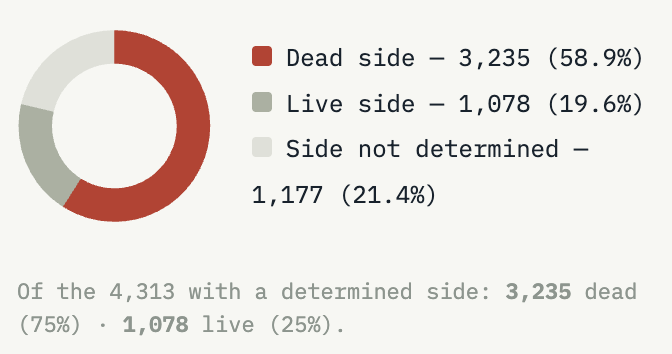
The AIM also suggests you enter the overhead join from the inactive side (the dead side). However, if that is not practicable, most pilots overfly the field from the active side (live side) 500′ above circuit altitude then do a 180° turn to return to the airport at circuit altitude.
Just less than 60% of traffic join the overhead from the inactive (dead) side of the circuit.
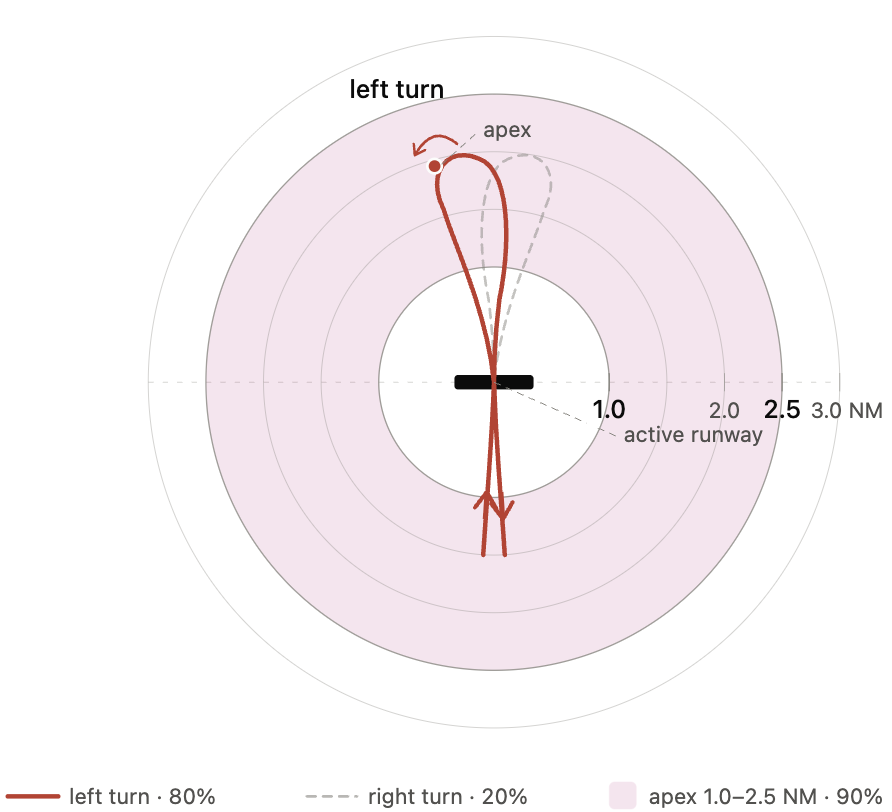
I calculated the turn apex (on the dead side) to be anywhere from 1-2.5 nm away from the airport. With most pilots making a left turn. Left turns make sense as it gives you better visibility in the turn to spot other aircraft.
By default circuits are all made in the left hand direction. However, some runways are to be flown with right hand circuits (CAR 602.96). This is usually due to noise abatement or for safety reasons. So the next question I had was: How compliant are pilots with this regulation and if the airport is quiet do they say “screw it” to the right hand circuit?
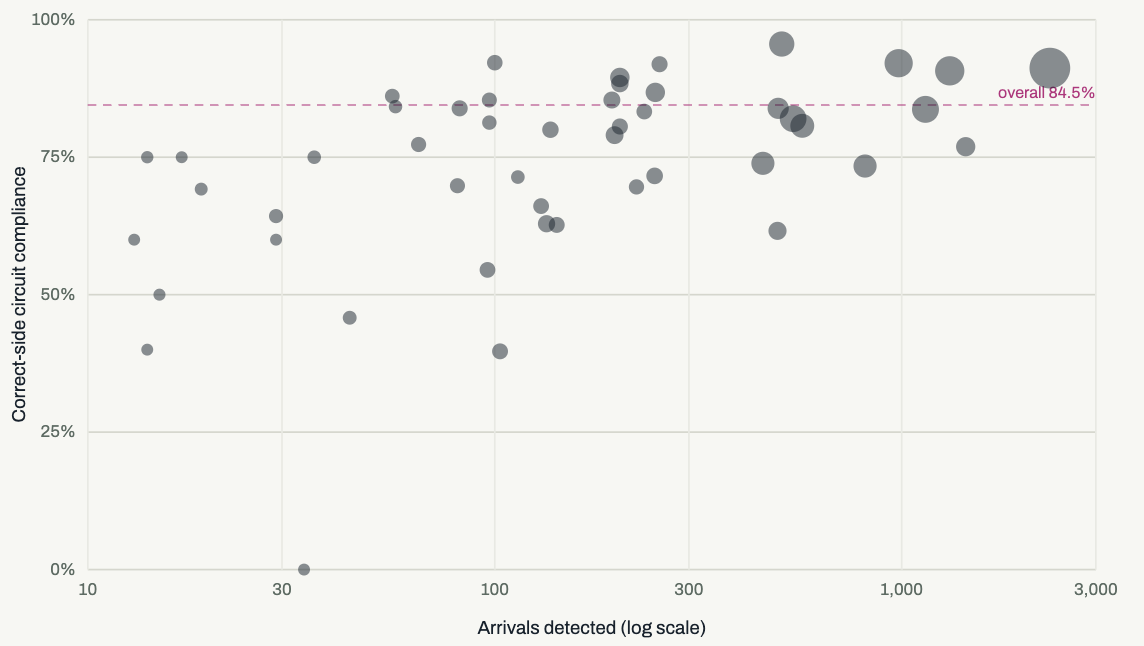
Overall there is an 85% compliance rate, however this rate does drop at airports that have less traffic.
I would caution drawing any specific conclusions about this especially for airports with 100 or less arrivals per year, as this could be a lone pilot on a quiet airport doing his thing.
Some Notable Events
Circuit Compliance at Sioux Lookout (CYXL)
Sioux Lookout airport has right hand circuits for runway 34, presumably to avoid overflying the city. However, it was a commercial operator of a PC12, not a private pilot that was violating CAR 602.96 and doing left hand circuits for 34.
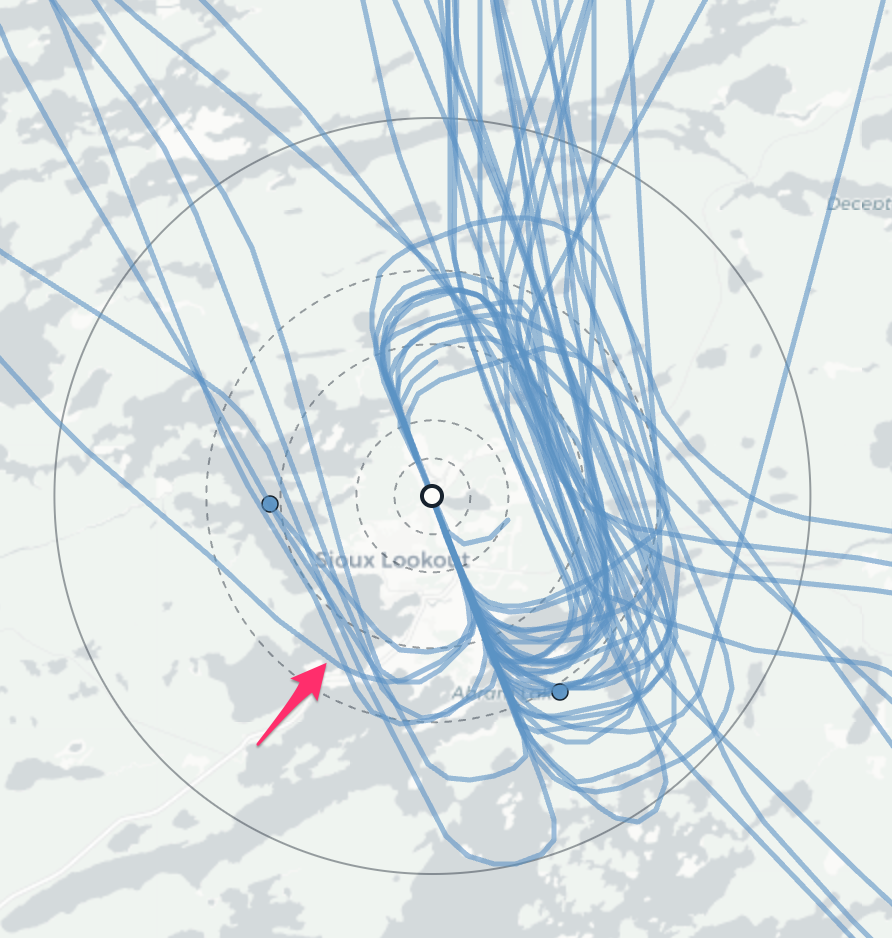
One can argue that a normal downwind circuit is performed anywhere from 0.5 to 1.5 nm from the airport. The majority of these flights are closer to 2nm away from the airport does not overfly the city. So that that as you will.
Turboprops/Multi Engines vs. Single Engine Pistons
Turboprops are usually flown by commercial operators in IFR flights. As such, they really don’t have an option to join the circuit other than with a straight-in approach.
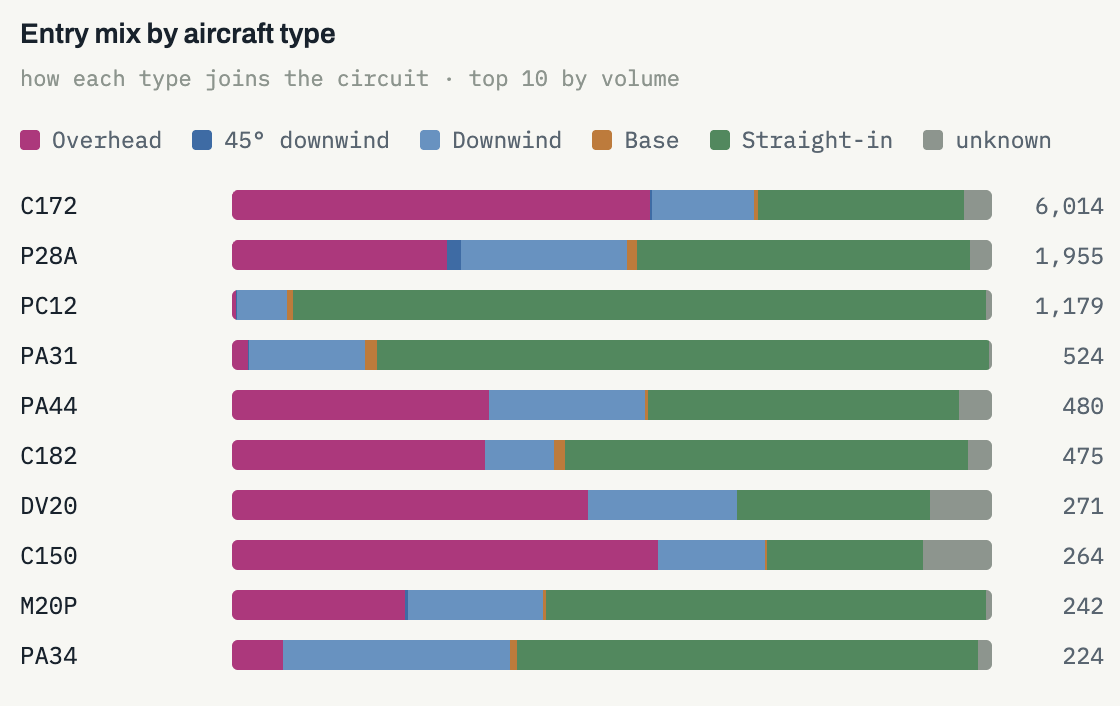
Aircraft such as the PC12, PA34, and PA31 all prefer straight-in approaches.
Conclusion
Overall the data meets expectation. Most pilots perform the overhead or downwind method for joining the circuit (at smaller airports). Airports with an MF or commercial operations prefer the straight-in entry method. Circuit compliance could be improved at smaller airports.
I calculated my algorithm to have an ~80% accuracy when classifying entry type. Of course the other 20% may be misclassified or reported as unknown. If you want to explore the data yourself, feel free to visit fly.blakecrosby.com/mid-field.