In Defence of Landing Fees: Yes, Really.
Why paying to land might actually be good for Canadian aviation.
Want to start an argument among pilots? Bring up landing fees.
Few things irritate general aviation pilots more than being charged $20, $30, or $50 simply to land an airplane. Flying is already expensive enough. Why should we have to pay just to use a runway?
Here’s an unpopular opinion: Landing fees aren’t necessarily a bad thing. In fact, they might be helping keep our airports alive.
Canada’s Aviation System Is Built Around User Fees
Canada’s aviation system relies heavily on a user-pay model.
NAV CANADA, for example, operates Canada’s civil air navigation system and recovers its costs primarily through charges to aircraft operators rather than general taxation.
Airports operate under a variety of ownership and funding arrangements, but many depend on revenue from landing fees, fuel sales, hangar rentals, leases, and other user charges to help cover their operating costs.
And those costs are substantial.
Runways need maintenance. Snow needs clearing. Lights need replacing. Grass needs cutting. Insurance needs paying.
None of that is free.
Yet many of us have become accustomed to landing at smaller airports without paying anything directly for the privilege.
Just because an airport doesn’t charge a landing fee doesn’t mean the landing was free. It means someone else covered the cost.
That might be local taxpayers, airport tenants, fuel customers, or other users.
So, What Does It Actually Cost?
According to the data I’ve collected for LandingFees.ca, landing fees at Canadian airports vary considerably. But they’re not nearly as widespread as you might think.
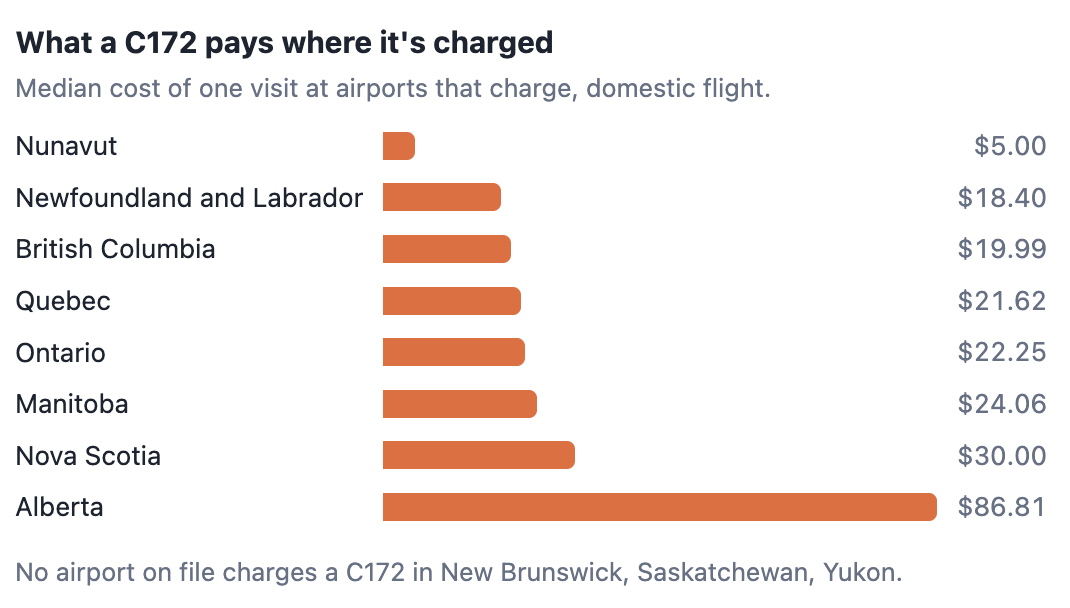
Consider a typical Cessna 172:
- 71 of the 106 airports with applicable fee information don’t charge anything for a domestic visit.
- Of the 35 airports that do charge, the median cost is just $20.27.
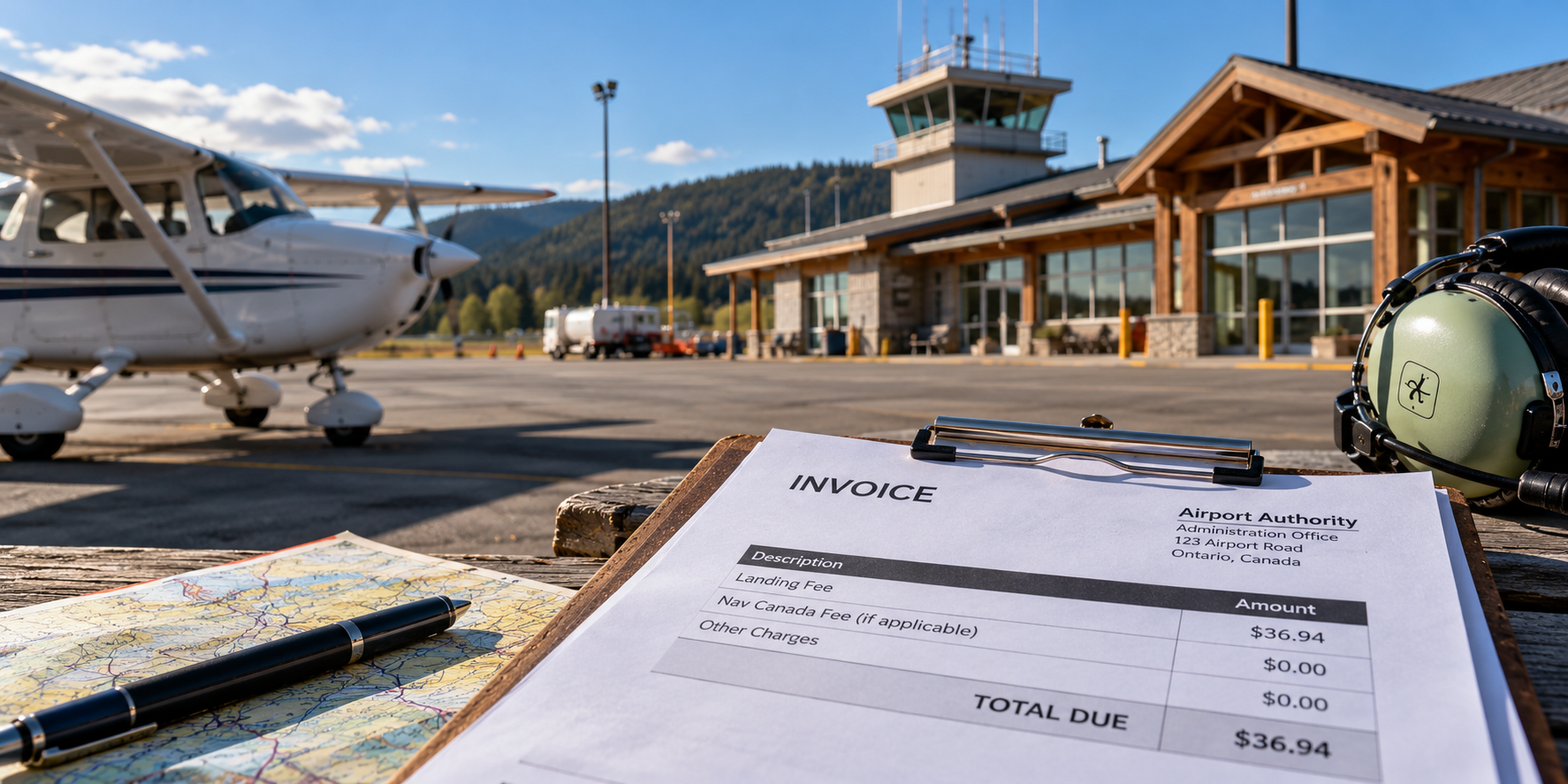
- At Hamilton International Airport (CYHM), the estimated charge is $36.94.
In other words, roughly two-thirds of the airports in the dataset with applicable fee information don’t charge a Cessna 172 at all.
And even at a busy airport like Hamilton, which accommodates commercial, cargo, and general aviation traffic, the cost is less than $40.
Here’s another interesting example: At Kenora (CYQK), the published domestic landing fee for aircraft weighing 2,000 kg or less is $20 plus tax. But purchase more than 50 litres of avgas, and the landing fee is waived.
That’s a sensible approach: encourage pilots to visit, sell some fuel, and support the airport’s operations.
It’s a reminder that landing fees don’t have to discourage general aviation. Structured appropriately, they can actually encourage it.
The Alternative Might Be No Airport at All
Across Canada, smaller airports face increasing financial pressure.
Municipalities must justify spending public money on facilities that some taxpayers perceive as serving only a handful of recreational pilots.
Of course, we know airports provide much more than that. They support emergency services, flight training, tourism, businesses, and regional transportation.
But those benefits don’t make the bills disappear.
A reasonable landing fee can provide another source of revenue and help demonstrate that airport users are contributing to the infrastructure they depend on.
Will a $20 landing fee single-handedly save an airport? Probably not.
But it can be part of a sustainable funding model.
And once an airport closes, it’s extraordinarily difficult to bring it back.
I’d rather pay $20 to land at an airport that’s still operating than land for free at one that’s about to disappear.
Reasonable Is the Operative Word
Supporting landing fees doesn’t mean supporting every landing fee.
There’s a considerable difference between charging a light aircraft $15 to help maintain an airport and charging that same aircraft $150 simply because the fee structure was designed around commercial aviation.
Fees should be proportionate, transparent, and appropriate for the aircraft and services involved.
They should also consider the economic activity visiting pilots bring to a community.
An airport charging excessive fees may discourage the very traffic that supports its fuel sales, businesses, and local economy.
Interestingly, the International Civil Aviation Organization (ICAO) recognizes that airports may use landing charges to influence traffic patterns, including encouraging general aviation aircraft to use alternative airports.
However, ICAO’s airport charging policies also emphasize fairness, equity, and the reasonable allocation of infrastructure costs.
In Canada, airport operators generally have considerable discretion in setting landing fees. There isn’t a blanket regulation prohibiting fees that discourage general aviation.
A landing fee that helps keep an airport operational is something pilots should be willing to discuss. A fee designed to make general aviation disappear deserves considerably more scrutiny.
And that’s where organizations like the Canadian Owners and Pilots Association (COPA) come in.
COPA advocates for general aviation and works to protect access to Canada’s airports and airspace. When airport policies, excessive fees, or proposed restrictions threaten that access, having a strong, organized voice representing pilots matters.
Because while it’s easy to complain about a $50 landing fee over coffee at the flying club, actually influencing airport policy takes considerably more effort.
If you care about keeping Canadian airports accessible, consider becoming a COPA member. The more pilots speaking with a collective voice, the stronger our ability to advocate for reasonable fees, fair access, and a sustainable future for general aviation.
After all, the goal isn’t necessarily free airports. It’s making sure we still have airports to fly to.
The Real Problem Is the Surprise
What frustrates me most isn’t necessarily paying a landing fee.
It’s discovering the fee after I’ve landed.
Some airports publish clear fee schedules. Others bury them in municipal bylaws or obscure PDFs. Sometimes you have to call someone just to find out what landing a Cessna will cost.
Pilots plan weather, fuel, routes, and alternates. Why shouldn’t we be able to plan airport fees just as easily?
That’s why I created LandingFees.ca, a resource for Canadian pilots to find and compare airport landing fees before departing.
The site currently contains 984 fee rules covering 134 Canadian airports, drawn from official airport fee schedules.
The objective isn’t to criticize airports for charging fees. It’s to make those fees easier to find, understand, and compare.
Because there’s nothing inherently wrong with paying for infrastructure we use.
But we should know what we’re paying before we use it.
The Bigger Picture
As pilots, we should be advocating for affordable access to airports, not necessarily demanding that every landing be free.
Canada’s aviation infrastructure depends heavily on its users, and general aviation has a role to play in keeping that infrastructure viable.
We can challenge excessive fees while recognizing that reasonable charges help support the airports we depend on.
So perhaps the next time we encounter a $20 landing fee, instead of immediately complaining, we should ask ourselves:
Would I rather pay $20 to land here today, or have nowhere to land here tomorrow?
Because a landing fee might be annoying.
But losing another airport costs us all a whole lot more.
LandingFees.ca — Know before you owe.