Articles in the Ground School Category
Air Law, Airmanship, Featured, Ground School, Interesting Things »
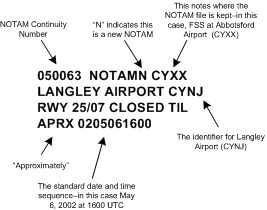
When you plan a flight, do you check the relevant NOTAMs? How do you know if they are important to you and your flight?
Did you know that if you cause a danger, incident, or accident because you didn’t check the NOTAMS you can be “charged” under CAR 602.71?
A NOTAM, or Notice To Airmen, is a way for Air Traffic Controllers (and other entities) to deliver important and timley information to the pilot. A NOTAM can disseminate information to:
Notify pilots of an error in a publication. In this case, the information …
Ground School, Instruments, Interesting Things »
I remember one time, during my training with an instructor, that I was landing at an airport. The instructor told me to ignore the VASI indicators as it was calibrated for the larger airplanes. Flying in a C172, I found that remark odd as I was under the impression that all VASI or PAPI would accommodate the C172 configuration.
I didn’t think much of it until today, a few years later, after reading an accident synopsis that indicated using the APAPI was a contributing factor to the accident.
There are three types …
Ground School, Instruments, Interesting Things, Navigation »
I was perusing the Transport Canada Instrument Procedures Manual today and noticed a rather interesting exercise:
It’s called the VOR Time Check and allows you to estimate the amount of time required to cross a VOR while flying a radial.
Here is how you perform it:
Let’s say you’re flying the 022 degree radial towards the VOR. Select a radial that is divisible by 10, so the 030 radial in this case. (Trying to do this with the 020 radial, only being a 2 degree difference would be difficult).
Now fly to that radial …
Aerodynamics, Ground School, Interesting Things »
Ground School, Interesting Things, Navigation »
On this day in 1920, the first ever flight using a “radio compass” was performed in Virginia.
It’s destination? A ship 100 miles off shore. Using only an AM radio station on the ship and a directional antenna on the aircraft, the pilot was able to fly directly to the Navy Ship.
Since then ADF has been refined and in some countries replaced. However it it still one of the primary form of navigation in countries like Canada, Australia, and other parts of the world with large vast distances.
Wired has more information …
Airmanship, Ground School, Interesting Things »
Aerodynamics, Ground School, Interesting Things »
“…If the engine fails on take-off with insufficient runway remaining, I will trim the aircraft for best glide and try to land withing 30° of the runway centreline.”
Ahh, the take-off briefing! This particular line is an important one. It’s not advisable to try to turn around after an engine failure on take-off. This video demonstrates why you shouldn’t.
With such a high bank angle at such a slow airspeed, the aircraft enters into a spin and crashes. The sad thing about this situation is that it looks like the pilot had …
Air Law, Ground School, Interesting Things »
A recent comment about flight plans by a reader has prompted me to write this post about flight itineraries.
Pilots have the option of filing a flight plan or a flight itinerary. There are important differences between to the two. It’s important to know what these differences are so you don’t expect a certain level of service that may be available when in fact it is not.
When do you need to file a plan or itinerary?
CAR 602.73(2) lets us know:
(2) No pilot-in-command shall operate an aircraft in VFR flight unless a …
Airmanship, Ground School, Training »
Let’s take a look at an example METAR with CRFI data in it:
CYFB CRFI 17/35 -22 .34 0201190630
In order, the block of data contains:
Airport/Station Ident
CRFI Indicator
Runway
Temperature
CRFI value
Date/Time reading was taken
So the CRFI for runway 17/35 is 0.34. We can use this value now to figure out how much extra runway we may need on landing. Let’s take a look at Table 1 in the AIM, Section AIR 1.6.6. You can also find the CRFI charts in the CFS.
If your performance calculations indicate that you will need 2000 feet of …
Airmanship, Ground School, Training »
Back in January of 2007, I breifly talked about the Canadian Runway Friction Index (CRFI). With the recent winter-like weather in Southern Ontario I figured this would be a good time to go into more detail.
Most progression in aviation safety is usually prompted by a previous accident or incident. The creation of the CRFI was no exception. A Fokker F-28 slid off the end of the runway at Dryden in March 1989, killing 24 of the 69 persons on board. Although the main cause of this accident was due to …